AI, a new normal?
Focus of the letter 25
Doodle Duel, which you will find in the publications, was the trigger for this focus. Beyond the game itself, it is the reflection it triggered that I wanted to share with you today.
I’ve already tested several games integrating generative AI and I’ve published a dozen of them on the site but while spending time playing Doodle Duel, a game with a simple and well-known mechanic, a question and a fear arose: since when did it become “normal” for me for an AI to be the referee of a game I play? Am I and are we integrating AI into our daily lives with less and less questioning as we did for GPS for example?
Since the beginnings of an AIday, admittedly at my level as an experimenter, I have been able to see the evolution at work month after month, from the simple messaging interface to today’s agents, including the generation of images, videos, music and voice.
With the update of the site’s article database, I had fun at the beginning of the week observing the evolution of the categories over these three years. I made a “multiple” visualization with Claude :
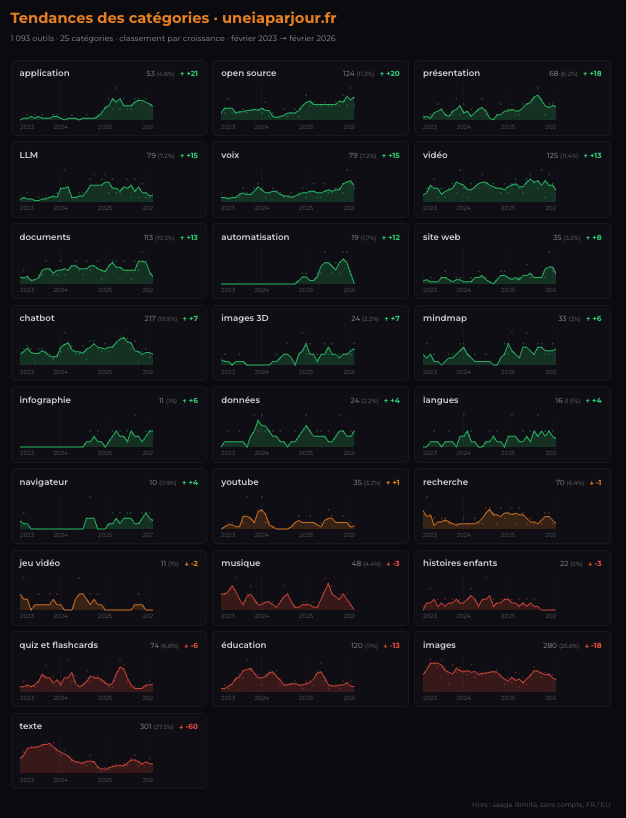
I accounted that, without any primary intention, the number of applications and the appearance of new categories followed this evolution:
- the text category is less and less present in favor of the multimodal “chatbot” category and with several models (text, search, image, etc.),
- the number of “LLM” articles showing the multiplication of models,
- video and voice with progressive advances in model capabilities,
- The gradual rise of the “open-source” category
- the appearance of the “infographic” category and more and more “presentation” keywords with the generation of credible text in images,
- applications, automation and browsers that appeared at the end of 2024 and in number has been increasing ever since. It is the gradual appearance of agentic AI that you will find in the readings shared with Jean-Luc Raymond’s article.
Technological progress has been dazzling both in terms of interfaces and possibilities, where we see the arrival of the generation of open worlds in real time (it’s Google’s Genie project already accessible in the USA) or we are told about “world models” (see again Jean-Luc Raymond’s article below).
This step-by-step progression, touch by touch, a new step that was unimaginable a few weeks ago making us forget the other, perhaps makes us forget too quickly the necessary questions about probability-based functioning, ethics, societal, environmental or mental health issues, more generally our relationships as humans with the machine.
Perhaps we need to question ourselves again, individually and especially collectively, about the persistence of these still necessary questions. Because by dint of playing with AI without thinking about it, perhaps it will also end up playing with us?
D'autres outils qui pourraient vous intéresser

Une IA par jour, une lettre d'info par semaine
uneIAparjour.fr c'est chaque jour une nouvelle application d'IA générative et une lettre d'info hebdomadaire avec les applications de la semaine, un focus et des lectures partagées.
By subscribing you agree to Substack's Terms of Use, our Privacy Policy and our Information collection notice.